
GRMS 101: Guest Room Management Systems for Canadian Hotels and Residential Towers
If you own, develop, or run a hotel, you have probably heard the term "guest room management system," or GRMS, without ever getting a straight answer about what it actually is. This guide fixes that. It is written for owners, developers, and general managers who are newer to the category, and it should also serve as a clean primer for the engineers and facilities staff who will live with the system day to day.
Howe Sound Solutions is a Canadian Authorized Service Integrator (ASI) for INNCOM by Honeywell, one of the longest-running names in hospitality room control. We will keep the first part of this guide vendor-neutral so you understand the category itself, then explain what INNCOM specifically brings and why properties choose to work with a specialist.
What a GRMS Actually Is
A guest room management system is the "nervous system" of a hotel room. Instead of a thermostat, a light switch, and a door lock all operating as unrelated islands, a GRMS ties the in-room devices together so they can share information and act intelligently. At a minimum, a modern GRMS coordinates several functions:
HVAC and energy management
This is the heart of the system and usually where the money is. A smart thermostat with an occupancy sensor knows whether a guest is actually in the room. When the room is rented but empty, the system eases the heating or cooling back to a comfortable "setback." When the room is unrented, it can pull back further. When the guest returns, the room recovers quickly to their preferred temperature. The guest never notices the savings — that is the point.
Occupancy detection
Occupancy sensing (often passive-infrared, sometimes combined with door and other inputs) is what makes the rest of the system smart. It drives the HVAC setbacks above, but it can also inform housekeeping, security, and energy reporting.
Lighting, drapes, and scenes
A GRMS can control room lighting and motorized drapes, and combine them into "scenes" — a welcome scene when a guest first enters, or a simple bedside "goodnight" control. In higher-end rooms and suites this is a visible part of the guest experience; in limited-service properties it may be minimal.
Door signage and DND
Digital "Do Not Disturb" and "Make Up Room" signage replaces the paper door hanger. Guests set their status from inside the room, and staff can see that status without knocking — which improves both privacy and housekeeping efficiency.
PMS integration
The property management system (PMS) is your reservation and front-desk brain. When the GRMS talks to the PMS, check-in and check-out events can automatically change how a room behaves — an unsold room stays in deep energy savings, and a freshly booked room is comfortable before the guest walks in.
Monitoring and reporting
A good GRMS gives operators a property-wide view: which rooms are occupied, which thermostats are misbehaving, where energy is being spent. This lets your team fix small issues before a guest ever files a complaint.
The Business Case (and the Canadian Angle)
Three benefits drive almost every GRMS decision:
- Energy savings. Guestroom HVAC is one of a hotel's largest controllable costs. Occupancy-based setbacks and PMS integration can meaningfully cut HVAC runtime. Published INNCOM figures for networked, PMS-integrated systems fall in the range of roughly 25–40% guestroom HVAC energy savings versus a traditional thermostat, depending on climate, occupancy, and building. Treat any number as a range to be validated for your property, not a guarantee.
- Guest comfort. Rooms that recover quickly to the right temperature, quiet automation, and simple in-room controls all reduce the friction that produces bad reviews.
- Staff efficiency. Digital DND, remote monitoring, and automatic room readiness let a smaller team run a tighter operation.
The Canadian angle matters here in two ways.
Cold-climate relevance. Much of Canada spends a large part of the year heating rooms, and shoulder seasons swing between heating and cooling. Occupancy-driven setbacks are especially valuable where the outdoor-to-indoor temperature gap — and therefore the energy penalty of conditioning an empty room — is large.
Utility rebates. Canadian utilities and efficiency programs frequently offer commercial incentives for HVAC controls and energy-management upgrades. At a high level, programs such as BC Hydro Power Smart business incentives, Hydro-Québec commercial efficiency programs, and equivalents from other provincial utilities can offset part of a qualifying project's cost. Program names, eligibility, and funding levels change often and vary by province and project — so use rebates as a reason to scope the project properly, and confirm current terms directly with the utility or through your integrator rather than budgeting on a number from an article.
How a GRMS Fits With PMS and Door Locks
Two integrations come up in almost every project.
PMS. As above, connecting the GRMS to your PMS is what turns a "smart thermostat in every room" into a genuine energy-management strategy. Check-in, check-out, and room-status events flow into the GRMS so energy behaviour follows the actual state of the business.
Electronic door locks. GRMS and locking are related but distinct systems. In some designs the room-control and locking worlds share information — for example, an online lock event can act as another signal about a room's state. The exact integration depends heavily on the lock vendor, the GRMS generation, and how the property is wired, so this is a classic "confirm the details before you assume it works a certain way" area. Lean on your integrator to map out precisely which systems talk to which.
The theme across both: a GRMS delivers its biggest wins when it is not an island. Planning the integrations early — ideally at design stage for new builds or major renovations — is far cheaper than retrofitting them later.
What "INNCOM by Honeywell" Brings
INNCOM has been building hospitality room-control and energy-management systems for decades, and Howe Sound Solutions specializes in it. Without reproducing product manuals, here is the shape of the platform:
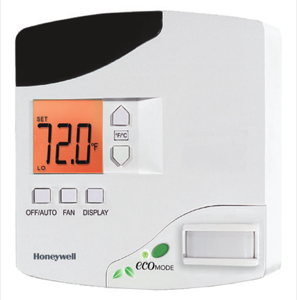
- Smart digital thermostats with built-in occupancy sensing that drive rented-but-empty and unrented setbacks. In the INNCOM line these are the E-Series devices, including models such as the e7 and the e528/e529 family.
- Room control and integration covering HVAC, lighting, drapes, DND/signage, and PMS and lock integration within one coordinated system.
- Central monitoring software — historically INNcontrol (properties may be running INNcontrol 3 today, with newer platforms such as INNcontrol 5 available) — that gives operators a property-wide, real-time view for monitoring and reporting.
For any specific device capability, wiring detail, menu path, or configuration limit, defer to your INNCOM documentation or ask an ASI. The right answer for your property depends on your exact hardware generation and how it was commissioned — which is precisely the kind of thing a specialist confirms rather than guesses.
Why Work With a Specialist ASI
A GRMS touches HVAC, electrical, low-voltage networking, the PMS, the locks, and the guest experience all at once. That is a lot of surfaces for a general contractor or in-house team to own alone. An Authorized Service Integrator like Howe Sound Solutions:
- scopes the system against your building, climate, and occupancy patterns;
- handles design, commissioning, and PMS/lock integration so the pieces actually cooperate;
- supports the property afterward, with a clear escalation path when something needs attention;
- and can help you frame a project so it lines up with available utility incentives.
The value of a specialist is not just the install — it is having someone who knows the platform deeply when a thermostat in room 412 starts behaving oddly at 11 p.m.
An Adjacent Market: Residential and Seniors Towers
The same technology that manages a hotel room applies well to multi-unit residential and seniors' living towers. These buildings share the core challenges — many similar suites, significant HVAC load, a cold climate, and a strong case for energy efficiency and centralized monitoring. Seniors' residences add a comfort-and-safety dimension where consistent temperature and reliable room-level insight matter even more. If you are developing or operating a residential or seniors tower, much of the GRMS thinking in this guide carries over, and it is worth a conversation.
Frequently Asked Questions
Will guests notice the energy setbacks?
Done well, no. The goal is for occupied rooms to feel exactly as comfortable as the guest expects while the savings happen in empty rooms. Room recovery speed is part of the design conversation.
Do I need to replace my PMS to add a GRMS?
Usually not. A GRMS is designed to integrate with your existing PMS. The specifics of which PMS platforms and versions are supported should be confirmed with your integrator for your particular setup.
Can a GRMS be added to an existing hotel, or only new builds?
Both. New builds and major renovations are the easiest time to integrate, but retrofit projects are common. The right approach depends on your building's wiring and current equipment.
How much energy will we actually save?
It depends on climate, occupancy, building type, and how deeply the system is integrated with your PMS. Published ranges exist, but the honest answer is that a proper site assessment gives you a defensible estimate for your property.
Are there Canadian rebates for this kind of project?
Often, yes — several provincial utilities offer commercial efficiency incentives that can apply to HVAC controls and energy management. Terms change frequently, so confirm current eligibility with the utility or your integrator before you budget.
Talk to Howe Sound Solutions
If you are planning a new property, a renovation, or an energy-efficiency upgrade — or you operate a residential or seniors tower and want to explore the same technology — Howe Sound Solutions can help you scope an INNCOM by Honeywell GRMS the right way for your building and climate. We serve hotels across Canada with trained INNCOM technicians.
Related: how we run INNCOM projects · parts catalogue · customer platform · contact us