
INNCOM e7 vs e528: which thermostat fits your hotel?
If you're specifying guestroom controls for a new build, planning a renovation, or replacing thermostats on an aging property, you'll run into two Honeywell INNCOM e-Series families: the current-generation e7 and the long-established e528. Both are hotel-grade energy management thermostats that do occupancy-based setback, talk to INNcontrol, and control most guestroom HVAC equipment. But they suit different buildings — and each has a battery-powered wireless sibling (the e7w and the e529) that changes the math again.
This guide walks the differences the way we'd walk an owner or chief engineer through them on site. Howe Sound Solutions is a Canadian Honeywell INNCOM Authorized Service Integrator, and this comparison reflects what we see in Canadian hotels, from downtown high-rises on fan coils to highway properties full of PTACs. For proprietary depth, confirm with your INNCOM documentation or an Authorized Service Integrator.
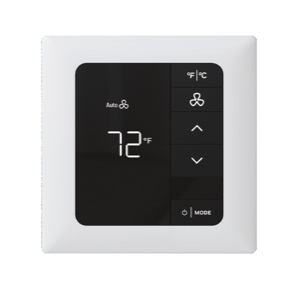
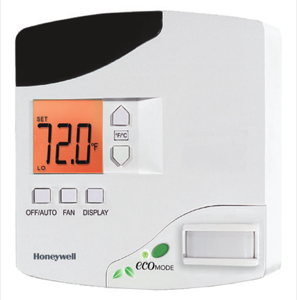
Two generations, one platform
This isn't a choice between competing products — it's between two generations of the same platform.
The e528 (with its wireless sibling, the e529) is the classic INNCOM guestroom thermostat: a proven design with a huge installed base, a backlit LCD, physical buttons, and the familiar green ecoMODE option. It was built flexible — low-voltage, line-voltage, and battery-powered variants, with or without PIR motion sensing, humidity sensing, and RF.
The e7 (with the battery-powered e7w) is the current flagship: a redesigned unit with a modern minimal look, a large backlit keypad, proximity wake, humidity sensing and control, Bluetooth alongside its Zigbee-based radio, and Amazon Alexa voice integration on supported deployments. Functionally it plays the same role — room brain, EMS controller, and hub for the INNCOM ecosystem.
Both run standalone or networked, and both feed INNcontrol. The decision is rarely "which one works" — it's "which one fits this building, this brand standard, and this renovation plan."
At a glance
Our own summary of the four units, built from the published datasheets:
| e7 (wired) | e7w (wireless) | e528 (wired) | e529 (wireless) | |
|---|---|---|---|---|
| Generation | Current flagship | Current flagship | Established classic | Established classic |
| Power | 24VAC or line-voltage | 4 AA batteries | Low- or line-voltage variants | 4 AA batteries |
| HVAC switching | Onboard relays + 0–10VDC output | Relay module + protocol converter at equipment | Built-in relays | Separate control hardware at equipment |
| Occupancy | Onboard PIR standard | Onboard PIR standard | PIR optional by configuration | PIR optional by configuration |
| Guest interface | Modern keypad, wakes on approach | Same styling, battery display | Classic LCD, optional ecoMODE button | Classic LCD |
| Humidity | Senses and controls | Sensing supported | Optional sensor | Optional sensor |
| Radio | Zigbee-based RF + Bluetooth; wired RS485 option | Zigbee-based RF | RF optional (aux comms available) | RF by design |
| Voice control | Alexa integration | Via platform | Not a headline feature | Not a headline feature |
| Retrofit trick | Smart wall plate stores config | No wall wiring | Oversized frame covers wall scars | No wall wiring |
Treat this as orientation, not a submittal — exact capabilities vary by model variant; confirm with your INNCOM documentation or an ASI.
Form factor and the guest experience
Guests never see your riser diagrams; they see the thermostat — and here the families feel most different.
The e7 looks like it belongs in a newly renovated room: a clean square face in Ice White or Black Onyx, a large temperature readout, and a tactile key column for fan, mode, and setpoint. It's deliberately quiet — untouched, it dims to a minimal display; as a guest approaches, proximity sensing wakes the backlight. A current-feeling device that doesn't glow all night over the bed.
The e528 is more utilitarian: a classic backlit LCD with dedicated buttons and, often, the green ecoMODE button inviting guests into deeper savings. It's thoroughly guest-proven but reads as an earlier generation. For a design-led brand standard, the e7 carries the day; on mid-cycle rooms, the e528's appearance is rarely a complaint driver.
Wired or wireless: four ways to put a thermostat on the wall
Each family splits into a wired unit and a battery-powered sibling — often the real decision.
e7 (wired). 24VAC or line-voltage models, five onboard relays for fan speeds, heating, and cooling, plus a 0–10VDC output for modulating equipment. Best where wiring exists or is being pulled anyway.
e7w (wireless). Four AA batteries, no HVAC switching of its own — it pairs over RF with a protocol converter and relay module installed at the equipment. The wall unit needs no wiring at all, the fast-install option where fishing wire to a better location is expensive or impossible. The trade-off: batteries to change and extra hardware at the fan coil or PTAC.
e528 (wired). Relays built in, with low-voltage and line-voltage variants that adapt to a wide spread of legacy wiring.
e529 (wireless). The battery-powered classic — four AA cells, RF communication, separate control hardware at the equipment, same pattern as the e7w.
One site walk usually settles it: where is the existing stat, where should it be for accurate sensing, and what would wire between those points cost? If the answer hurts, wireless wins.
How each family detects occupancy
Occupancy detection is where the savings live — INNCOM's published figure is up to 35% on guestroom HVAC versus a traditional thermostat.
The e7 ships with an onboard PIR motion sensor as standard, alongside light and proximity sensing. Occupancy logic combines motion with a door switch or door-lock integration, so the system can tell "guest left" from "guest sleeping" — the logic we unpack in our e7 field guide.
On the e528/e529, the PIR is a configuration option rather than a given: units were ordered with or without motion sensing, with the ecoMODE button as an alternative or complement. The same approach works well on the classic family — but verify what your units actually shipped with. On older estates we regularly find a mix, and a PIR-less stat relying on ecoMODE alone leaves savings on the table.
Buying today? Make motion sensing the baseline and design door-switch or lock integration in from day one, whichever family you pick.
HVAC compatibility, at a concept level
Both families were built for the equipment actually found in hotel rooms — two-pipe and four-pipe fan coils, PTACs, and heat pumps, including multi-stage configurations. Honeywell's claim that the e-Series controls virtually any guestroom HVAC system holds up in the field for both generations.
The e7 adds headroom on newer mechanical plants: its onboard 0–10VDC output supports modulating valves and variable fan drives directly. Both families list heat pump configurations, but for Canadian properties moving toward electrification, the e7's I/O flexibility is the more future-proof choice when the mechanical design isn't final yet.
One cold-climate note: in Canada, setback strategy matters more than the spec sheet. Deep unoccupied setbacks that are harmless in Phoenix need freeze-aware limits in Prince George. That's configuration, not hardware — plan for it, and confirm details with your INNCOM documentation or an ASI.
How each joins the property network
Both families communicate on 2.4 GHz using the 802.15.4 protocol, feeding room data to INNcontrol through the property's INNCOM infrastructure.
The e7 is the better-connected device: Zigbee-based RF, plus Bluetooth, plus an available wired RS485 option running Honeywell's DeepMesh protocol for properties with a wired backbone. The e528 offers RF as an option (other auxiliary comms existed historically); the e529 is wireless by design.
Practically: on an existing networked INNCOM property, new thermostats join the infrastructure your current units already use — a strong argument for staying within the platform. On a new build, the e7 lets your integrator choose wired or wireless networking per the building's realities. Either way, network design — channels, room addressing, floor infrastructure — is integrator work; get it engineered, not improvised.
Retrofit vs new build
New build or gut renovation: the e7 is the default. You control the wiring, wall locations, and mechanical spec, so install the current generation with the most I/O and the longest runway.
Occupied-building retrofit: where the wireless siblings shine. The e7w or e529 goes on the wall with no wiring, control hardware installs at the equipment, and rooms return to service quickly — often the difference between renovating around occupancy and blocking rooms.
Replacement on an e528 property: two sane paths. Stay with the classic family where units remain available, keeping rooms uniform; or step up to the e7, designed to live on the same platform. One e7 retrofit advantage: the smart wall plate captures a room's configuration and loads it into a replacement automatically. And check that any replacement covers the wall footprint of what came off — nobody wants a paint shadow around a new thermostat.
Renovation timing: replace thermostats with the reno, not before — repainting, furniture moves, and new mirrors or metalwork all affect PIR sightlines and RF behaviour. Re-verify RF health in renovated zones before handing rooms back.
Availability and lifecycle, honestly
The e7 is Honeywell's current-generation INNCOM thermostat and the safe bet for a decade-plus horizon. The e528/e529 family remains documented, with an enormous installed base — but as with any long-running product, assume future platform investment flows toward the newer generation. Running e528s today is no reason to panic-replace working hardware; it is a reason to standardize your spares strategy and decide which family your next renovation lands on. For current availability, confirm with your INNCOM documentation or an Authorized Service Integrator — a question we answer for properties weekly.
The decision checklist
Run your property through these questions:
- Is there wiring where the thermostat should be? Yes → wired e7 (or e528 like-for-like). No, and pulling wire is painful → e7w or e529.
- New build or major reno? → e7 family, full stop.
- Existing e528 estate, mid-life rooms? → keep the estate uniform for now; plan the e7 transition with your next reno cycle.
- Modulating valves, VFD fans, or an evolving mechanical design? → the e7's 0–10VDC output earns its keep.
- Brand standard emphasizing modern room design or voice control? → e7.
- Do your existing units actually have PIR sensors? → audit before assuming; occupancy sensing drives the savings.
- Battery tolerance? Wireless models mean scheduled AA replacements in every room — budget the labour.
- Cold-climate setback plan? → whichever hardware, have setback limits engineered for Canadian winters.
FAQ
Is the INNCOM e528 discontinued? The family remains documented, has a very large installed base, and we service it routinely. For current orderability of specific variants, confirm with an Authorized Service Integrator — the e7 is the current-generation product.
Can I replace an e528 with an e7 in the same room? The e7 was designed as the successor on the same platform, with wired variants for low-voltage and line-voltage applications. Wiring, mounting footprint, and network configuration need checking room-type by room-type — a real but routine engineering task for your ASI.
What's the difference between the e7 and the e7w? The e7 is wired, with onboard relays switching the HVAC directly. The e7w is battery-powered, pairing with a protocol converter and relay module at the equipment. Same family, same interface — different installation model.
Do these thermostats work without a network? Yes. Both run standalone, controlling HVAC and managing occupancy-based energy locally. Networking adds INNcontrol monitoring, PMS integration, and remote diagnostics.
Which saves more energy? The savings come from occupancy logic, not the faceplate. A well-configured e528 with PIR and door integration will outperform a poorly configured e7 — commissioning is where the money is.
Who supplies and installs INNCOM thermostats in Canada? Honeywell INNCOM products are deployed and serviced through Authorized Service Integrators. Howe Sound Solutions is a Canadian ASI providing supply, installation, commissioning, and service.
Talk to Howe Sound Solutions
Choosing between the e7 and e528 families is really choosing an installation model, a renovation sequence, and a ten-year platform plan — and the answer differs between a 40-room highway property on PTACs and a 300-room tower on fan coils. Howe Sound Solutions is a Canadian Honeywell INNCOM Authorized Service Integrator: we audit estates, spec replacements, commission networks, and keep both generations running. Weighing a thermostat decision — or troubleshooting units you already own (see our e7 field guide and e528 troubleshooting guide)? Contact Howe Sound Solutions and we'll walk your property with you.
Related: e7 thermostat support · parts catalogue · customer platform · contact us