
INNcontrol 3 to INNcontrol 5: What an Upgrade Really Involves
If you run a hotel with an INNCOM guestroom management system, there's a good chance the front end you log into every day is INNcontrol 3 (IC3). It has quietly managed thermostats, occupancy, and energy savings across your property for years. It works — until the day it doesn't, and you discover the platform underneath it is aging faster than the building it controls.
This guide is written for chief engineers, general managers, and owners who are weighing the move to INNcontrol 5 (IC5). It explains, in practical terms, why the upgrade matters, what actually carries over versus what gets replaced, how the migration runs, what to expect for downtime and room availability, and how to budget. It is deliberately high-level on proprietary detail — for the specifics of your exact device mix and firmware, lean on your INNCOM documentation or an Authorized Service Integrator (ASI).
Why Upgrade at All?
IC3 Is Aging Software on Aging Assumptions
INNcontrol 3 was designed for a different era of hotel IT — a single on-site workstation, a flat network, and an operator who trusted everyone with physical access. That model has not aged gracefully. As the software gets further from its original release, finding compatible workstations, keeping the operating system supported, and sourcing spares all get harder and more expensive.
The Security and Support Angle
There is also a documented security dimension. In 2020, the U.S. Cybersecurity and Infrastructure Security Agency (CISA) published an advisory covering INNcontrol 3 (ICSA-20-049-01, tracking CVE-2020-6968). At a high level, it describes an improper-privilege-management issue in IC3 version 3.21 and earlier: under the right local conditions, an ordinary workstation user could escalate their privileges inside the application by editing local configuration files. Importantly, it was rated as not remotely exploitable — this is not an "internet attacker takes over your hotel" scenario. But it is a clear signal that the platform's security model reflects its age, and Honeywell's own guidance pointed toward updating affected software, tightening accounts, and restricting system access to authorized staff.
For an owner, the takeaway is simple: running a system that shows up by name in a public government advisory is a conversation you'd rather not have with a brand auditor, a cyber-insurance underwriter, or a franchisor's IT team. Moving to a current, actively maintained platform takes that item off the table.
What You Actually Gain in IC5
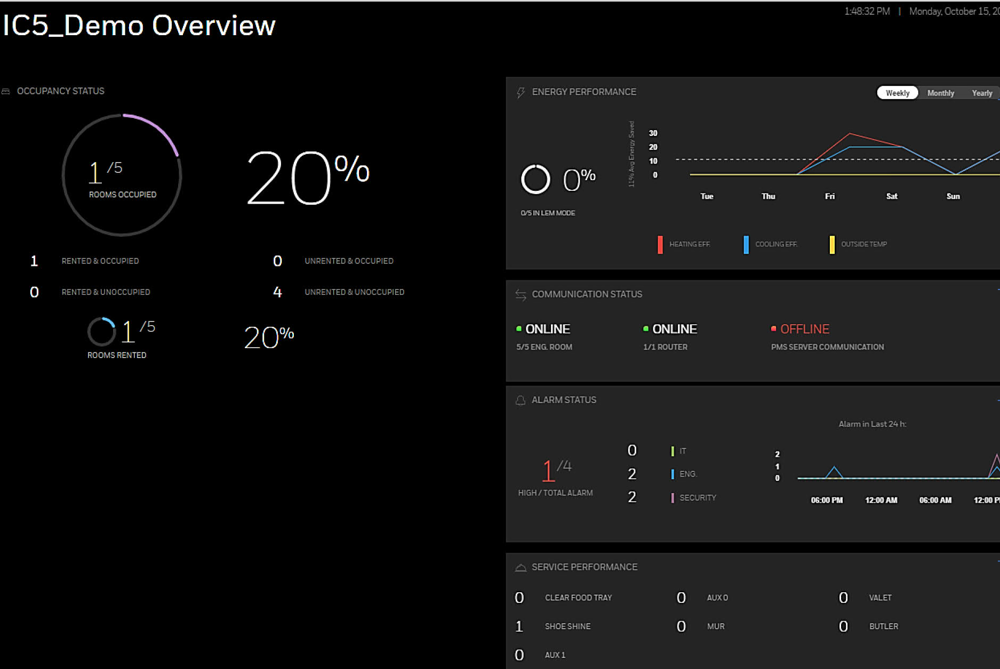
INNcontrol 5 is not just IC3 with a new coat of paint. It is a genuinely different platform built on the Niagara Framework — an open, widely used building-integration standard — which changes what the system can see and do:
- A real dashboard. IC5 rolls up property-wide and per-room energy use, live occupancy, and overall system health into configurable views, so your team is watching KPIs instead of hunting through screens.
- Live occupancy intelligence. Housekeeping and maintenance can service rooms when guests are away; the system logs occupancy history and can flag doors left open.
- Integration that isn't a special project. Because it speaks Niagara, IC5 connects more cleanly to property management systems (PMS), central electronic locking, and other third-party building systems.
- Cloud hosting and automatic updates. IC5 can run on a secure Honeywell-hosted cloud platform, which simplifies updates, backups, and secure remote access — and supports managing more than one property from a single pane of glass.
For a group with several properties, that last point is often the whole reason the project gets funded.
What Actually Carries Over
This is the question every engineer asks first, and the good news is that the answer is favorable.
The Field Layer Usually Stays
The parts of an INNCOM system that are expensive and disruptive to touch are the ones buried in the walls: the low-voltage wiring runs, the in-room thermostats and controllers (the E-series devices such as thermostats and control units), door and occupancy sensors, and the network cabling tying rooms back to the property. In most upgrades, this field layer is reused, not ripped out. Your rooms keep the hardware guests already interact with.
What Changes Is the Brain and the Front End
The upgrade concentrates on the head-end: the supervisory software (IC3 becomes IC5), the server or hosting arrangement it runs on, and sometimes the network gear and gateways that connect the field devices to the new supervisor. Older-generation controllers or gateways may need firmware updates or, in some cases, replacement to talk cleanly to IC5. Exactly which units are reused versus swapped depends entirely on your installed generation and firmware — this is precisely the kind of detail an ASI confirms during a site survey rather than something you should assume from a blog post.
The Honest Version
Reused in most cases: room wiring, guestroom thermostats and controllers, sensors, structured cabling. Reviewed and possibly replaced: head-end server, network/gateway hardware, aging or end-of-life controllers. Replaced: the IC3 software itself. The migration is far more of a "new brain on your existing nervous system" than a gut renovation.
The Migration Process, at a High Level
A well-run IC3-to-IC5 project follows a predictable arc:
1. Site survey and inventory. An integrator documents your device generations, firmware, network topology, and integration points (PMS, locks). This is where the real scope is set.
2. Design and data migration plan. Room configurations, schedules, and setpoints are mapped from IC3 into the IC5 model so you don't rebuild the property by hand.
3. Head-end build. The new supervisor is stood up — on-site, cloud-hosted, or hybrid — and integrations are configured and tested in a controlled way before it touches live rooms.
4. Cutover, typically phased. Rooms or floors are brought onto IC5 in groups, verified, and signed off.
5. Commissioning and handover. The team validates energy logic, occupancy, alarms, and reporting, then trains your staff on the new dashboard.
Downtime and Room Availability
This is usually less painful than owners fear. Because the in-room hardware stays live and the work concentrates on the head-end, most of the effort happens on the server and network side rather than inside occupied rooms. When individual rooms do need attention — a controller firmware update or a quick verification — it's typically a short, per-room task that can be scheduled around housekeeping and low-occupancy windows.
A phased cutover is the standard approach: a floor or block at a time, so the property never goes fully "dark" on controls and you always have a known-good fallback. The right sequencing depends on your occupancy patterns, and a good integrator plans it with your rooms division, not around them.
Budgeting Factors
There is no single sticker price, but the variables are knowable:
- Per-room count. Total room quantity is the biggest driver. More rooms means more device verification and cutover labor.
- Reuse vs. replacement. A property whose field devices and gateways are recent and healthy costs less than one that needs controller or network replacement along the way.
- Hosting model. On-premise, Honeywell cloud, or hybrid each carry different up-front and ongoing cost profiles.
- Integrations. PMS and electronic-lock integrations add value but also scope.
- Phased vs. all-at-once. Phasing spreads cost and risk over time and is easier on operations; a compressed all-at-once cutover can suit a property already in renovation or a seasonal closure.
A phased plan lets many properties fund the upgrade across budget cycles while capturing IC5's energy and labor benefits on the floors that convert first.
How Howe Sound Solutions Runs It, Canada-Wide
Howe Sound Solutions is a Canadian Honeywell INNCOM Authorized Service Integrator. Our INNCOM-trained technicians handle the full arc — survey, migration planning, head-end build, phased cutover, commissioning, and staff training — for hotels across Canada. Because we work with these systems every day, we scope from what's actually installed in your building rather than a generic template, and we plan cutovers around your occupancy so guests barely notice the platform underneath them changed.
Frequently Asked Questions
How long does an INNcontrol 3 to INNcontrol 5 upgrade take?
It depends mostly on room count and how much of the field layer is reused. The head-end build and testing happen up front; the room-facing cutover is then phased floor-by-floor. A site survey is what turns "it depends" into a real schedule for your property.
Do I have to replace all my thermostats and room controllers?
Usually not. The in-room hardware and wiring are typically reused, and the upgrade focuses on the supervisory software and server. Some older controllers or gateways may need firmware updates or replacement — an integrator confirms this during the survey.
Is INNcontrol 3 a security risk?
INNcontrol 3 is named in a public CISA advisory (ICSA-20-049-01) describing a local privilege-escalation issue in older versions. It was rated as not remotely exploitable, but it reflects the platform's age. Moving to the actively maintained IC5 platform is the clean way to close that gap.
Can I upgrade the hotel one floor at a time?
Yes — a phased, floor-by-floor cutover is the standard approach. It keeps rooms in service, spreads cost across budget cycles, and always leaves a known-good fallback during the transition.
What's the difference between INNcontrol 3 and INNcontrol 5?
IC3 is an older on-site front end. IC5 is a modern platform built on the open Niagara Framework, adding property-wide dashboards, live occupancy intelligence, cleaner PMS and lock integrations, cloud hosting with automatic updates, and multi-property portfolio management.
Ready to Scope Your Upgrade?
Every property is different, so we quote from a real look at your building rather than a guess. Our INNCOM-trained technicians serve hotels Canada-wide and will walk you through what carries over, what changes, and a phased plan that fits your occupancy and budget.
Talk to Howe Sound Solutions: info@howesoundsolutions.com Ask us for an INNcontrol 5 upgrade assessment and quote.
Trained INNCOM technicians, Canada-wide, with quote-first parts.
Book a site assessment Request a parts quoteRelated: how we run INNCOM projects · parts catalogue · customer platform · contact us